
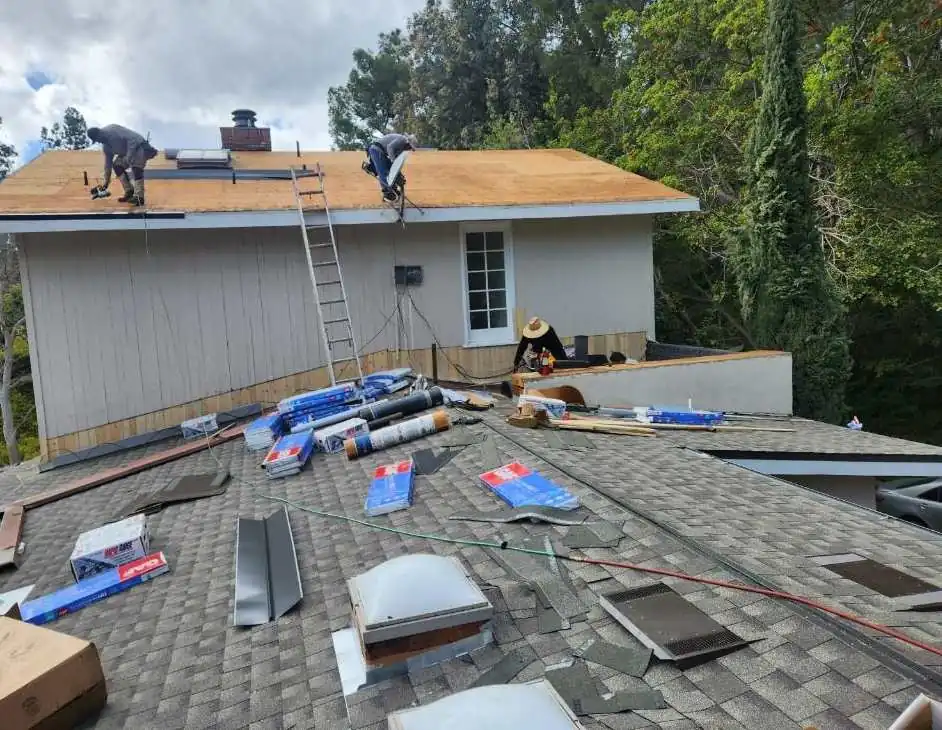
When a roof has failed across the whole building, patching it stops making sense. A full replacement removes everything down to the wood deck and rebuilds the roof from there.

We do that work on Pasadena houses, apartment buildings and smaller commercial properties. Call (626) 240-1360 and we will price it for free.
The first question is whether the roof requires replacing at all. We assess the condition, explain repair versus replacement, and price the work we propose to do.
When a Roof Needs Full Replacement Instead of Repair
A roof needs full replacement when the covering has failed across the roof rather than in one place. Shingle curling and splitting on whole slopes is one sign.
Underlayment that tears as soon as we lift it is another sign. Leaks in several separate spots point the same way.
Decking that gives underfoot belongs on that list as well. One damaged area on an otherwise sound roof does not, and that case belongs with a targeted roof repair instead.
Age alone does not decide it, because two roofs of the same age can sit in very different shape. Sun exposure, pitch, ventilation and the quality of the last installation all move that date around.
Repeat leaks on one slope are a reason to look under the covering. The underlayment can be failing across that whole plane while the tile or shingle above it still looks sound.
Wind damage sits in its own group. Wind can lift a run of shingle or a band of tile and leave the rest of the roof intact. That stays repair work.
Granule loss is worth watching on a composition roof. Bare mat showing across a slope means the surface has stopped working.
Existing layers matter as well. A roof already carrying more than one covering changes the tear-off and the disposal. Our page on residential roof work covers houses and small apartment buildings more widely.
What a Full Tear-Off and Reroof Includes
A full replacement takes the roof back to bare wood and rebuilds every layer above it. We take off the old covering, the old underlayment and every piece of old flashing. We replace decking that has gone soft, lay new underlayment, set new flashing, and finish with the new covering.
The deck is the wood layer that carries the whole covering above it. With the old material off, every board is visible. We cut out boards that have gone soft, split or come apart in layers before anything new goes down.
New underlayment then covers the whole deck. That layer does the waterproofing between the finished covering and the wood.
New metal goes in at the walls, the chimney, the valleys and each pipe opening. Flashing seals the places where two surfaces meet and move against each other. A replacement renews all of those transitions at once.
Drip edge, starter course and roof ventilation go back new with the rest of the roof. The finished covering goes on last.
Roof Deck Repair and Other Conditions Found at Tear-Off
Roof deck repair is the change that most often moves a replacement scope. Nobody can price a board that is still covered.
That is why the proposal names the likely finds before the first bundle comes off. Four conditions belong on that list for an older roof.
- Soft or delaminated decking. Those boards come out, and new sheathing goes in before anything lands on them.
- Stacked coverings. Two or more layers on one deck grow the tear-off and the haul away.
- Flashing that has corroded or pulled loose. New metal goes in at every wall, valley and chimney while the deck is open.
- Patched vent and pipe openings. New boots and a fresh seal go in at each opening.
We show you what the tear-off turned up before the scope changes.
Tearing Off Versus Roofing Over the Old Covering
Tearing off is the default on replacement work, because it is the only way to see and correct the deck. Roofing over an existing layer covers up whatever is wrong underneath. It also leaves two layers to remove the next time the roof is replaced.
A tear-off takes more days and more disposal than covering over. It buys new underlayment across the whole deck and new flashing at every transition. Where the covering is a single layer and the deck is sound, the question is genuinely open.
Choosing the New Roof Covering
The new covering follows the roof, the building and what sits up there now. Pitch decides what belongs on the roof at all. Weight decides much of the rest, because a deck framed for shingle will not automatically carry tile.
Composition shingle is the usual choice on a pitched roof. Our asphalt shingle roofing page covers how those roofs go on.
On a tile house the tile itself is often worth keeping. Our page on clay and concrete tile roofing explains when we relay it.
Where a deck runs flat or close to it, a different system goes on. Our flat and low slope roofing page covers the torch down work we use.

For long panels joined at raised seams, standing seam metal roofing sets out the buildings it suits.
Changing from one material to another can mean structural work before roofing work. A heavier assembly on framing that was never sized for it is a structural question, and it comes first. Call (626) 240-1360 with the material you have now, and we will price the replacement around it.
Replacing One Slope or the Whole Roof
Some buildings need one plane replaced rather than the entire roof. That works when the rest of the covering is sound and the two areas can be joined cleanly.
A partial reroof still carries its own scope.
Matching is the first question on a partial job. A covering that has weathered for years rarely matches new material straight off the pallet.
The joint is the second question. Where new roofing meets old, we rebuild the flashing and the courses at that line rather than butting them together.
How much of the roof comes off can also change what the City asks for on the permit.
Roofing Permits and City Checks Before a Reroof
Which documents a reroof needs depends on the scope of the work. On a replacement we help the property owner get the required roofing permit. Pasadena publishes its current requirements through the Permit Center.
Requirements and approval are the City's call, not ours. No website can settle either one for a particular property.
Historic designation is a separate check. Some Pasadena properties sit inside designated landmark districts, where the City can review a change of roofing material. The City publishes guidance for owners of designated historic properties, including its historic preservation incentives.
An older block is not automatically a designated one. The address settles that, not the age of the street.
Fire hazard mapping is the third check that can shape a replacement. Official fire hazard severity zone maps place parts of Pasadena in the High and Very High categories. A mapped area can raise the fire rating the finished roof assembly has to carry.
The official map and the City settle whether an address sits in one of those areas. Our guide to Class A roof requirements works through the mapped zones and the scopes that carry the rule.
Roof Replacement and a New Roof on Supplied Plans
Replacement work happens on a building that already stands, and its structure sets the limits. A new roof built from drawings runs as its own job. Our page on building a roof from supplied plans covers that work.
We scope the two differently. We take the old roof off, find out what the deck needs, and rebuild from there. On a new build the drawings already describe the roof.
Sometimes an addition is on the drawing board while the existing roof is failing. We write those two scopes separately, so neither one hides inside the other.
Roof Replacement in Pasadena, CA
Roof Replacement Questions Pasadena Owners Ask
Should a 20-year-old roof be replaced?
Not on age alone. A twenty-year-old roof earns a replacement when its condition says so.
That means brittle or torn underlayment, covering damage across whole slopes, soft decking, or leaks in more than one place. We assess the roof's actual condition rather than the year it went on.
Do you tear off the old roof or go over it?
We tear off by default. We consider going over the old covering only where a single layer sits on a sound deck. Stripping to the deck is the only way to see the wood and replace what has failed.
New underlayment then goes across the whole roof. Roofing over an old covering hides the deck problems and adds weight to the framing.
Is a full roof replacement quote free?
Yes. We quote a full replacement at no charge, on a house or a commercial building.
A detailed roof inspection with a written report is paid work. That report stays separate from the free replacement quote, so tell us which document you need.
Do you help with the roofing permit for a reroof?
Yes. We help you get the roofing permit that the city with jurisdiction requires for a reroof.
What a project needs follows its scope. Only the City can settle that for a specific address.
Start a Free Roof Replacement Quote
A quote starts with the address and the age of the roof if you know it. Tell us about any work already done up there, and where water has shown up inside.
We name the work we propose and price it. You decide what happens next.
We quote replacement work in every part of Pasadena. Villa Parke and Madison/Oakland sit inside 91101. Linda Vista/Annandale sits in 91103, Altos Arroyo in 91105, and Michillinda Park in 91107.
The same name and city appear on our Google Business Profile, Pasadena Roofing Contractors, Pasadena CA. Call (626) 240-1360 and we will price the replacement work you are considering.
Find Pasadena Roofing Contractors on Google Maps
Pasadena Roofing Contractors
Pasadena CA
(626) 240-1360