
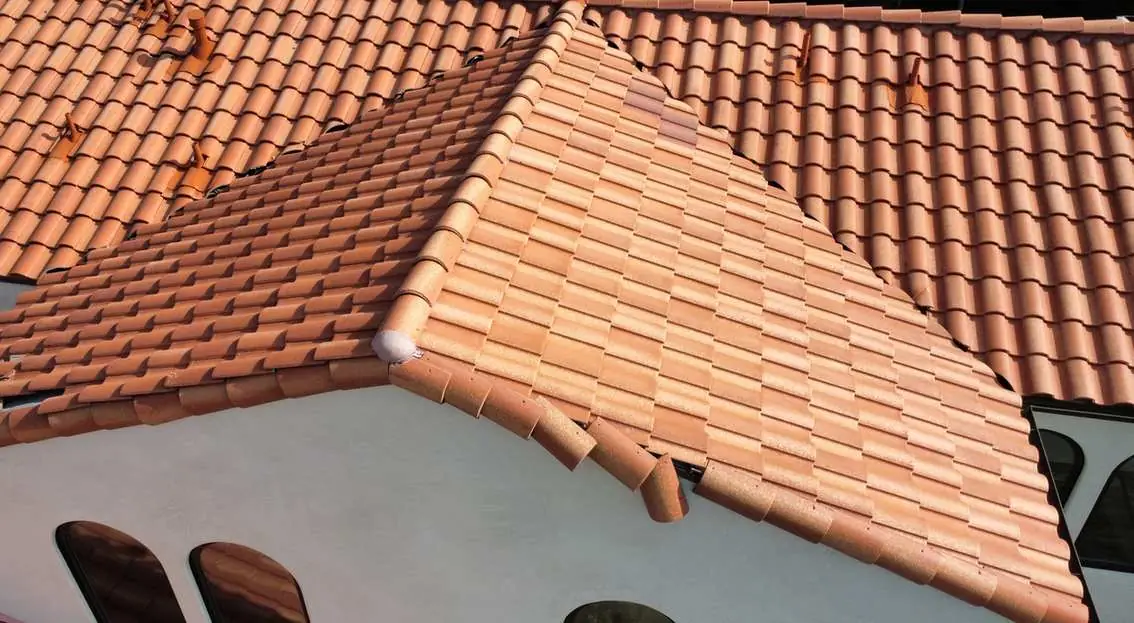
A tile roof works as two layers doing two different jobs. The tile takes the sun, the wind and the impact, and it throws most of the rain clear. Underlayment is the waterproof sheet lying beneath that tile, and it stops whatever gets past.

How a Tile Roof Sheds Water
That division explains most tile roof trouble. Tile is rigid and heavy, while the sheet beneath it is a softer material working in the heat. Wood decking sits below both, and every fastener on the roof penetrates it.
Flashing closes the joints at chimneys, at wall lines and in the valleys where two slopes meet. Those metal details usually deteriorate before an open field of tile does.
Clay, Concrete and Slate Tile Behave Differently
Clay, concrete and slate are the three tile materials we work on, and each handles differently on a roof. Clay is fired terracotta, usually curved into a barrel or an S profile.
Concrete is formed in a mold and is frequently shaped to imitate another material. Slate is stone, separated into thin flat pieces.
The material changes how a piece breaks, how easily we can match it, and how we move across the roof.
- Clay chips at the edges and cracks along its curve, and older profiles are the hardest to match.
- Concrete tile is heavy, so we read the ridge lines and fascia for sag before planning work.
- Slate splits along its grain, leaving a clean edge and thin slivers that turn up in the gutters first.
Profile matters as much as the material. A barrel tile sits on a raised course and lifts differently from a flat interlocking piece.
Clay and concrete both take mortar at the hips and the ridges. That mortar cracks as the roof moves, and loose ridge pieces follow it.
What Broken and Slipped Tile Means for the Roof
Broken and slipped tile is the portion of the problem anyone can see. A piece fractures, slides out of its course, or appears in the driveway after a windy stretch. Every gap it leaves admits sun and rain straight onto a sheet built to sit covered.
One piece rarely moves alone. We check the courses above and below the gap, because the same fasteners can let go across a small area.
Ridge and hip tile sits on the lines where two slopes meet, and it absorbs the most movement. Crumbled mortar up there loosens the top course, and hip pieces begin shifting individually.
Debris does gradual damage. Leaves and needles pack a valley, water backs up beneath the tile, and the sheet remains damp.
Foot traffic leaves its own evidence. Antenna work, solar work and gutter cleaning all concentrate weight on tile, and the cracks appear later.
Telling a Tile Problem From a Problem Underneath
Tile trouble and underlayment trouble leave different evidence, and only one of them appears as broken pieces. A tile roof can leak with every piece still sitting in its course. We determine which layer failed by lifting tile in a small area and interpreting what sits under it.
A small lift shows whether the sheet has gone brittle and whether fasteners tore through it. It also shows whether the wood below stayed dry. And it shows how your tile handles, which matters before a larger section comes off.
Sound tile over a spent sheet points at renewing the layer under your tile rather than at a new roof. That page sets out how the lift and relay runs.
Tile that keeps breaking under normal handling weighs against a lift and relay. So does decking that has gone soft across the field instead of in one corner.
We name the layer the work belongs to when we report back to you.
Reusing Your Own Tile and Where Matching Runs Out
We plan to reinstall your existing tile wherever it is still sound. Those pieces were cut for this roof, for its courses, its hips and its openings. New pieces come in only where old ones fractured.
Older profiles resist a piece for piece match, and some have disappeared from the market entirely. We tell you that before any tile comes off, not afterward.
Ridge and hip pieces need their own count, because they were cut and bedded differently from field tile.
Color shifts on a roof after years of sun, so new pieces read as new for a while. Where a close match does not exist, you decide where the replacements go. A blended patch on a back slope is one decision, and a visible front elevation is another.

Where a Tile Roof Meets a Low-Slope Section
A tile main roof often meets a low-slope surface over a porch, a den or a rear addition. That joint is a common place for water to get in, and it needs metal built for the transition. We look at it whenever we scope tile work.
Water speeds up down the tile slope and reaches the flat section all at once. Edge metal and gutters below the joint carry the same load, and water backs up where they sit low.
Tile also overhangs that joint and hides the metal underneath. We lift the bottom courses to see its condition rather than judging it from the ground.
Tile on a Designated Pasadena Landmark Property
On a designated Pasadena landmark property, changing the roofing material can bring a City material review into the project. The City's design guidelines for historic districts speak to specialty roofing materials. They ask that a material such as tile go back as matching material where that is feasible.
Keeping your own tile on the building is usually the straightest way to meet that guidance. Which properties the review reaches is narrower than the guidance alone suggests, and the City settles it.
The City keeps its current guidance together on a design guidelines index. Our guide to roofing in a designated district works through how the City's separate lists differ.
Tile Repair, New Underlayment, or a New Roof
Three routes cover most tile work, and what we find on the roof points at one of them. A repair resolves a defined problem inside a small area.
New underlayment keeps your tile and renews the waterproofing beneath it. A complete rebuild changes the roof system itself.
- Tile repair resets and swaps pieces and rebuilds the flashing in that area, where the wood below is dry.
- Lift and relay keeps your tile and replaces what sits under it, where the sheet is spent.
- Full rebuild puts new covering and new layers over a repaired deck, where tile and wood have both failed.
A handful of loose or cracked pieces stays with ordinary repair work on the failed area. Tile coming apart over soft decking is different work. That job becomes a rebuild of the whole roof.
We scope each route on its own, so you can weigh them against what the roof showed. Dry weather makes tile work easier, because tile handles better and new material bonds properly.
We quote tile work across the city. La Cresta Drive sits in 91103 and Mountain Place in 91104. Villa Corona falls inside 91106, and East Eaton Wash sits in 91107.
Whether a tile job needs a roofing permit depends on the project's scope. Our team assists property owners in pulling the required permit. For work within city limits, the permit route starts at Pasadena's Permit Center.
Tile Roofing in Pasadena CA
What Callers Ask About Tile Roofing
Do you work on clay, concrete and slate tile?
Yes. Clay, concrete and slate are all tile we repair, relay and replace, on houses and on commercial buildings. Name the one overhead and we will scope the work around it.
Can you replace a few broken tiles without redoing the roof?
Yes, when the sheet and the wood under that area are still doing their job. We reset the pieces that only moved, swap the ones that cracked through, and rebuild the flashing there. What the lifted pieces show decides whether the job stays that size.
Is a tile roofing quote free?
Yes. We price tile repairs, relays and rebuilds at no charge. A documented written roof report is separate paid work, so say which of the two you want.
Name the Tile and We Will Take It From There
Call (626) 240-1360 and name the material as best you can. Clay, concrete or slate, plus what you can see from the ground, is enough to start.
Say whether water has come through inside, and roughly where. Those two details usually tell us which part of the roof to open first.
You will find us on Google Maps as Pasadena Roofing Contractors, Pasadena CA. Call (626) 240-1360 and the tile quote costs you nothing, whether the job is six pieces or a whole slope.
Find Pasadena Roofing Contractors on Google Maps
Pasadena Roofing Contractors
Pasadena CA
(626) 240-1360