
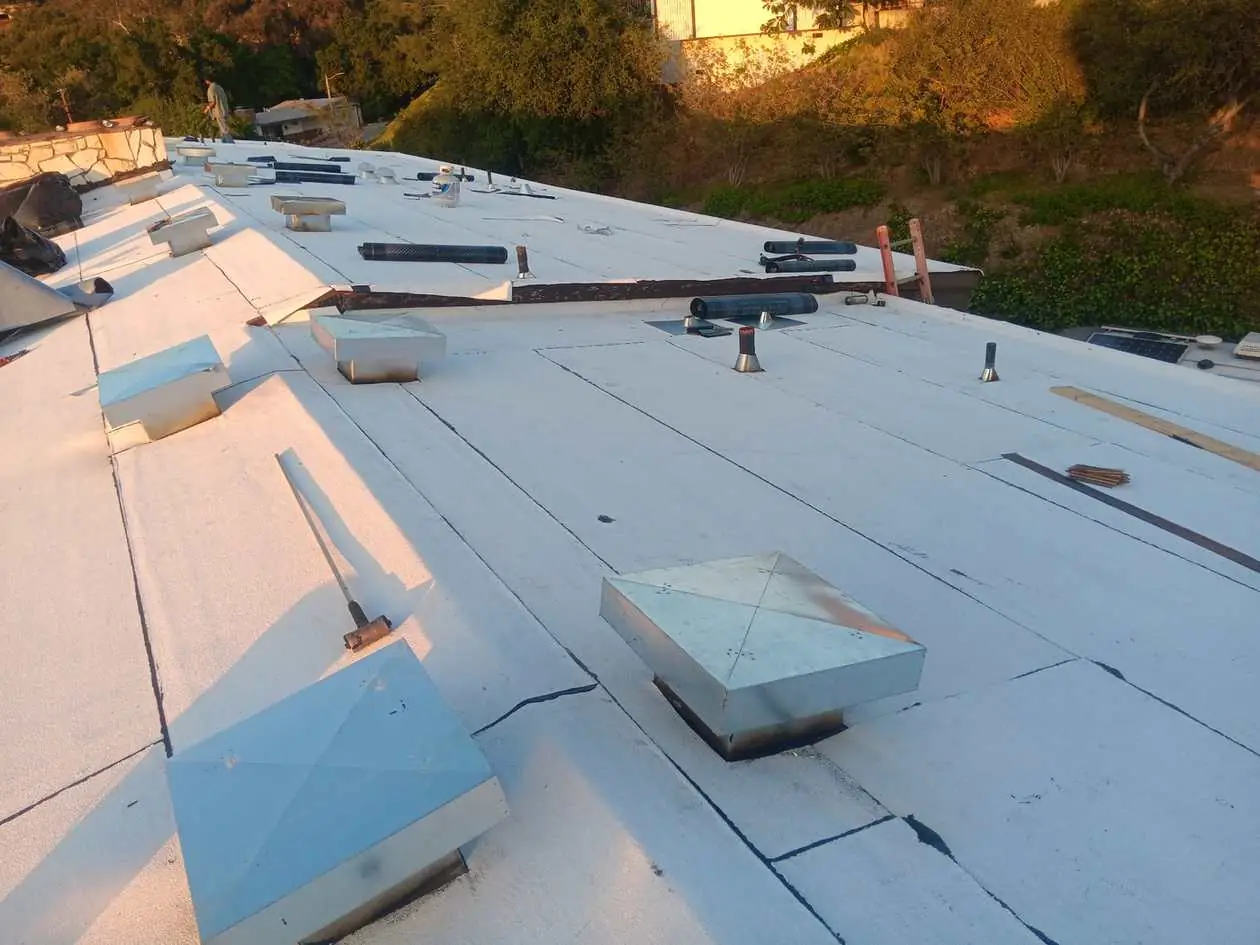
A flat roof on a house rarely covers the entire building. The shallow section usually sits over a rear addition, a carport, a garage or a deck above a room. That area requires a sealed surface rather than tile or shingle.

What Makes a Roof Low-Slope
A low-slope roof is one too shallow for tile or shingle to shed water on their own. It still carries pitch, but water crosses it gradually instead of running off quickly. So the surface itself has to stay sealed, and the laps, the flashing and the outlets do the waterproofing.
Roofers separate low-slope work from steep-slope work for a reason. The materials, the details and the failure points all change with the pitch. The National Roofing Contractors Association publishes guidance for low-slope membrane roof systems along that same line.
The pitch on these roofs is real and difficult to see from the yard. You notice it when water gathers at one end after rainfall and takes its time leaving.
Houses carry them too, not just warehouses. A rear addition, a carport or a garage roof behaves like a small commercial roof sitting on a house.
Flat Roof Repair and Replacement Work We Do
We repair and replace flat roofs on houses, additions, porches, garages and carports. A repair reseals open laps, rebuilds flashing at walls and curbs, and closes damaged membrane. A replacement strips the existing surface off, opens up the deck, and lays a new membrane across the section.
What sits under the surface shapes the work, so we find out how many layers the roof carries. Additional layers change what has to come off.
Laps are the overlaps where two sheets bond together, and they carry most of the risk on a shallow roof. We cut back to sound material and reseal or reweld the joint.
Flashing ties the flat field to everything standing next to it. Wall lines, vent pipes, skylight curbs and roof edges all rely on it. We rebuild those details as part of the work.
A curb is the boxed frame holding a skylight or a unit above the surface. The membrane has to turn up and over it, and that turn takes more attention than the open field.
Water has to leave the roof somewhere. We clear the drains and the scuppers, then examine the edge metal carrying the rest away.
Once the existing surface comes off, the wood shows itself. We replace soft or split sheathing before new membrane goes down.
What to Note on the Flat Section Before You Call
Examine the joints and the edges first, because a flat roof usually opens up there. Lifted laps, split blisters, bare patches and debris packed at a drain all belong in that note. What you can see from a window is worth reporting, not a diagnosis.
- Laps that have lifted, curled or pulled apart.
- Blisters or bubbles raised above the surface.
- Bare spots where the granules or the coating have worn off.
- Water still sitting days after rainfall, or a ring where it sat.
- Leaves and grit packed around a drain or a scupper.
- Cracked or lifted flashing where the flat roof meets a wall.
Marks inside the building matter as much as anything on the roof. A damp corner in a closet counts. So does a stained light fixture, or paint lifting at the top of a wall.
Say when you first noticed it, and whether it happens after every storm or only the heavy ones. Both details change what we examine first.
Call (626) 240-1360 and describe what you found up there. The flat roofing quote is free.
Flat Roof Repair or a Full Membrane Replacement
Repair and replacement suit different flat roofs, so we scope the route from what the roof reveals. A repair fits a section that failed in one place while the rest of the membrane still holds water out. A replacement fits a surface worn out across the area, or one where water has already reached the wood.
A repair stays inside its area. We open the failed section, rebuild the detail properly, and tie new material back into the surface around it. Repair work on a failed section follows that same order.

A replacement resets the entire flat area. We strip the existing surface, read the deck, swap damaged boards, and install new membrane across every plane.
Water coming into a room below moves that section to the front. We handle it first and plan the rest around it. Roof leak repair covers tracking that water back to its entry point.
Some buildings sit between the two routes. One failed section over an occupied room can go now, and the rest can follow later. We price both routes so you can compare them.
Flat Roof Systems: Modified Bitumen, Single Ply and Coatings
Three families cover most flat roofs on a house, and modified bitumen arrives in heavy rolls welded at the laps. Single-ply membrane arrives as a wide plastic sheet, and TPO is one common single-ply name. Coatings are liquid surfaces applied over a roof that is already there.
| System | What it is | Where it turns up |
|---|---|---|
| Modified bitumen | Asphalt sheets in rolls, bonded at the laps with heat | Flat sections on houses, additions and garages |
| Single ply | A wide plastic membrane seamed together, TPO among them | Larger decks and business buildings |
| Coating | A liquid surface applied over the roof already there | Upkeep on a membrane that still holds |
Whichever sheet goes down, the flashing at the walls and the curbs does the hardest part of the job.
A coating is worth naming carefully. Spreading a new surface over a failing membrane covers the trouble underneath instead of closing it. So we examine what a coated roof is hiding before we scope anything.
Manufacturers publish the documentation that specifies which base sheets, plies and lap methods make an approved assembly. Polyglass maintains its technical resources online for the modified bitumen sheets.
The system already on your roof shapes a repair, and the system you choose shapes a replacement. Torch-applied modified bitumen has a page of its own, because it is our default low-slope offer.
Flat Sections on Houses and Flat Roofs on Business Buildings
Flat and low-slope roofing serves houses and business buildings alike. We repair and replace the flat area on a home, and the same work on a commercial property.
On a home the flat area sits over one part of the building, not the whole roof. On a shop, an office or an apartment block the flat deck can cover everything.
A larger commercial deck brings questions a house roof never raises. Start with flat roofing on a commercial building if that describes your property.
Flat sections turn up in every part of the city. We quote owners in 91106 around Jefferson Park, 91103 around Lincoln Triangle and 91104 around Brigden-Ranch. Altos Arroyo owners in 91105 reach us on the same number.
Flat Roofing Questions Owners Ask
What are the common problems with flat roofs?
Water leaves a flat roof gradually, so anything that stops it becomes a problem. The joints, the flashing and the drains take the strain first. Sun and foot traffic wear the surface itself over time.
How often should my flat roof be inspected?
We do not publish a set schedule, because flat roofs differ that much. Take a look after a heavy rainstorm, and again if anyone has been working up there.
Tell us what you noticed when you call. A documented written roof report remains separate paid work, so mention that requirement directly.
Is it better to repair or replace a flat roof?
It depends on the condition of the flat section, not on its age. A single failed area on a sound surface usually calls for a repair. Once water has reached the wood below, that section needs replacing.
Tell Us About the Low-Slope Section
Call (626) 240-1360 and describe the flat area. The building type, what covers the roof currently, and where water shows up inside are enough to start.
Say roughly how old the surface is, and whether anyone has patched or coated it before. Previous work changes what we find when we open the roof up.
Find us on Google Maps under Pasadena Roofing Contractors, Pasadena CA. Ask for your free flat roofing quote at (626) 240-1360.
Find Pasadena Roofing Contractors on Google Maps
Pasadena Roofing Contractors
Pasadena CA
(626) 240-1360