
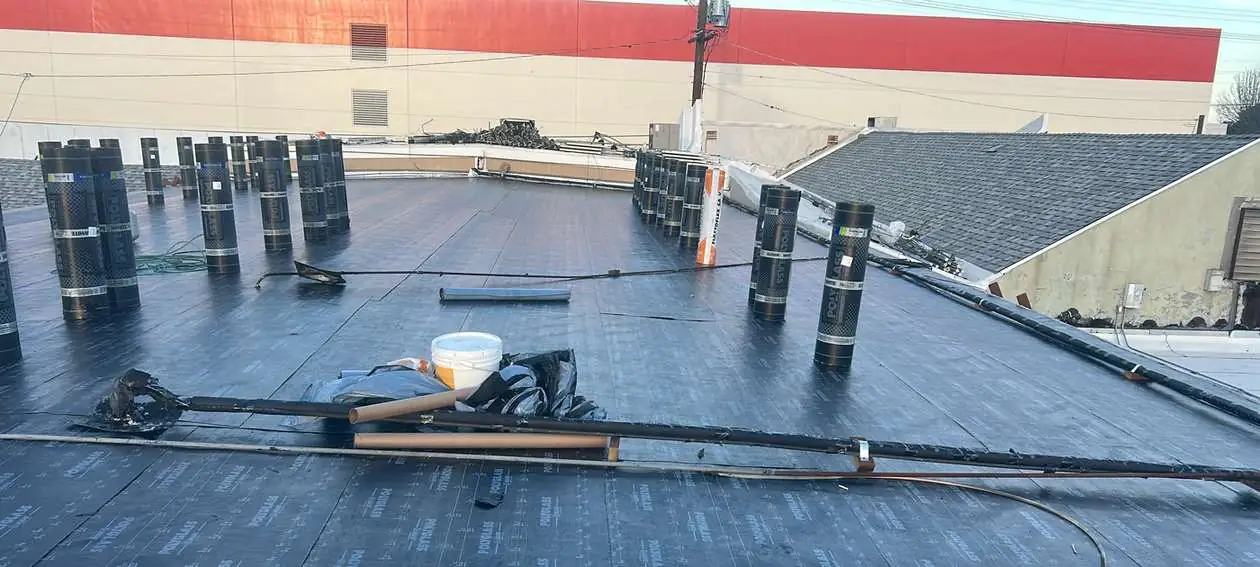
Torch down roofing is a modified bitumen system for flat and low-slope roofs. The membrane arrives in heavy rolls, and a roofer heats the underside as the sheet unrolls. That heat bonds the sheet to the layer below, and the welded laps leave one continuous surface.

What Torch Down Roofing Is
The trade also calls it torch-applied modified bitumen, and bitumen is simply the asphalt in the sheet. Modified means the manufacturer blends polymers into that asphalt, so the membrane stays flexible in heat.
Plies are what separate this system from a single-sheet membrane. We build the roof up in layers that bond together, and the top layer carries the granule surface.
Torch-applied modified bitumen is our default low-slope offer rather than an automatic verdict on your roof. We say so plainly when another low-slope system suits your deck better.
How We Install a Torch-Down Membrane
We build a torch-down roof from the deck upward, and the existing covering comes off first. Once the deck is bare, we replace soft or split boards before any new material goes down. Only then do the plies go on in order, each one bonded to the layer underneath.
The deck also has to be dry before the first ply goes over it. Sheathing that stayed wet holds moisture against every layer above, so it comes out first.
Drainage sets the layout on a low-slope roof. We plan which way the laps run around the places where water actually leaves the surface.
- Base sheet: the first ply fastens to the deck and gives the layers above something to bond to.
- Interply sheet: a middle ply adds thickness where water sits longest and drains slowest.
- Cap sheet: the top ply carries the granule surface and takes the sun and the rain.
Laps take the most attention on this system, because each sheet rolls over the one before it. We weld that overlap until the joint behaves like membrane instead of a seam.
Flashing finishes the roof, so the membrane runs up parapet walls and equipment curbs. Those upturns then tie into metal at drains, scuppers, vents and skylight curbs.
Edge metal closes the perimeter, and we set it to shed into the gutter line. We also keep new membrane clear of the drain openings.
Where the Torch Stops and Cold-Applied Detail Starts
Torch work stops wherever an open flame does not belong. Beside wood siding, a dry parapet or a skylight curb, we switch to a self-adhered, cold-applied product. That area finishes without heat, and the assembly still ties together as one membrane.
We mark every spot where the torch stops and a cold-applied sheet takes over. Those transitions go slower and in smaller pieces. Heat, hot bitumen and a live flame belong with people who handle them daily.
Some flat roofs are wrong for the method altogether. A deck crowded with combustible penetrations points somewhere else, and so does a surface no one can strip.
Polyglass Polyfresko G, the Cap Sheet We Fit
Polyfresko G is the cap sheet we reach for on torch-down work. Polyglass builds it as an APP modified bitumen membrane with a granule surface, made for heat-welded application. The reflective white granule surface is the finished layer you would stand on.
APP stands for atactic polypropylene, the polymer blended into the asphalt. Sheets made that way suit torch application rather than a cold adhesive. So we choose the product and the application method together.
Polyglass reports a Solar Reflectance Index of 96 for the new surface, and 82 once weathered. Those figures sit on the Polyfresko G product page, measured by the manufacturer.
We read that as a material specification and leave it there. A published property of a sheet is not a promise about a building.
The cap sheet is still only one component of the assembly. Polyglass publishes its wider system documentation in a set of technical resources. The deck, the plies below and the flashing carry as much of the result.
Which Low-Slope Decks Suit a Torch-Down Membrane
A torch-down membrane suits the shallow parts of a building. The flat roof over an addition, a porch or a garage qualifies. So does the back half of a house that grew over the years.

Slope comes first in that assessment, then drainage, then the deck under both. A flat section may have been re-covered more than once, and stacked systems limit the options. We strip a roof carrying several old coverings rather than cover it again.
An older flat section often drains toward one point, and that point serves the whole area. The junction with the pitched roof beside it needs a detail of its own. Water leaves shingle or tile quickly, then meets a surface that moves it slowly.
Torch-down work suits low-slope decks throughout the city. We quote it for owners in 91107 near Michillinda Park and in 91106 near Mentor Catalina. Owners in 91103 near East Arroyo and in 91104 near El Molino Orchard reach the same team.
A torch-down job may need a roofing permit, and our team helps property owners pull what the work requires. The city with jurisdiction makes those rules and gives the final approval. Confirm the requirement for your address with that city.
Patching a Modified Bitumen Roof or Replacing the Membrane
A patch and a full replacement suit different problems. A patch suits a local failure on an otherwise sound membrane. That means an open lap, a split at a curb, a failed drain detail or a puncture.
A full replacement follows when the membrane has worn out across the field. We also replace when the deck already carries several old systems.
We examine the entire field rather than the one spot you noticed. Blisters, open seams and soft spots underfoot say more about the membrane than a single leak does.
Previous work on the section matters too, and a membrane laid over trapped moisture began with a problem. So we ask about the last roofing work done on that deck.
Repairs have a real place, and we do them. A contained roof repair closes the failure you have now, and the larger decision can wait.
Other Low-Slope Systems We Fit
Torch-down is not the only low-slope system we install, and the building usually points at the right one. A house with a single flat section asks one question. A large deck carrying mechanical units and daily foot traffic asks another.
For a house, we compare the flat roofing options side by side. For a store, an office or an apartment building, start with flat roofs on commercial property.
We also install TPO, the single-ply sheet many commercial projects name by specification. Which system fits depends on the deck, the drainage and the traffic the roof carries.
Torch Down Roofing Questions Pasadena Owners Ask
What is torch down roofing?
Torch down roofing is a modified bitumen membrane bonded with heat. A roofer warms the underside of the roll, and the sheet melts onto the layer below. The laps weld shut, so the finished surface runs continuous instead of overlapping in pieces.
Is torch-down a fit for my flat roof?
Torch-down fits most stripped low-slope decks with sound wood underneath. The deck, the drainage and the covering already up there decide whether it fits. A deck crowded with combustible penetrations, or one nobody can strip, points at a different system.
What problems turn up on a torch-down roof?
The joints and the details usually give out before the open field does. We look hardest at laps that have opened and at splits where the membrane turns up a wall. Blistering across the surface and blocked drains belong on the same list.
Is a torch down roofing quote free?
Yes, we price torch-down repairs and full membrane replacements at no charge. The documented written roof report is a separate paid product, so say which one you want.
Ask Us Whether Torch-Down Fits Your Deck
Call (626) 240-1360 with the property address and a rough size for the flat section. Name what covers it now, and say where water gets inside.
We will say plainly whether torch-down suits that deck. Then we will explain what a patch or a full membrane replacement would involve.
Our Google Business Profile lists Pasadena Roofing Contractors, Pasadena CA. Call (626) 240-1360 and the torch-down quote is free.
Find Pasadena Roofing Contractors on Google Maps
Pasadena Roofing Contractors
Pasadena CA
(626) 240-1360