
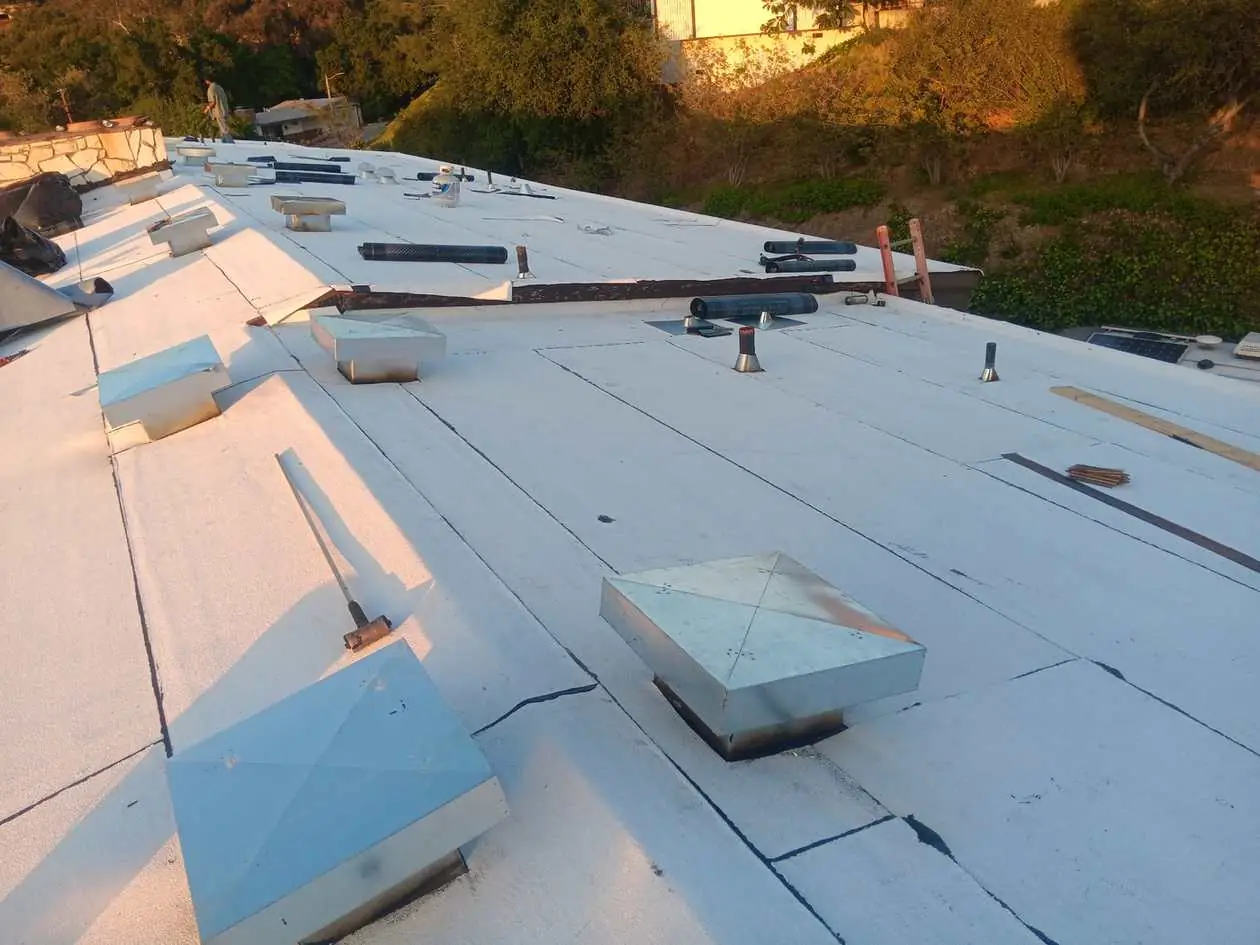
TPO is a single-ply roofing membrane designed for flat and low-slope decks. The sheet arrives in wide rolls and covers the entire deck in one waterproofing layer. Single ply means one layer performs that job, instead of several plies assembled on site.

What TPO Roofing Is
A TPO sheet joins to itself at hot-air welded seams. The letters stand for thermoplastic polyolefin. Thermoplastic sheet softens under heat and fuses back to itself, which is what makes that weld possible.
A low-slope roof drains to points rather than shedding down a pitch. Water leaves at a drain or a scupper instead of running off an edge. That difference changes what a covering has to do.
TPO is an available option on a commercial low-slope roof of that kind. Where a project specification names a single-ply membrane, that is the system we install for it. Thickness and reinforcement belong in that specification rather than in a phone call.
Where TPO Fits on a Commercial Low-Slope Roof
TPO suits some low-slope roofs and not others, so we judge the fit from the roof itself. Drainage behavior, deck condition and penetration count are the initial inputs. The layers already on the deck and the activity in the space below matter just as much.
Trapped moisture is the biggest factor. Old layers retain water long after somebody patched the leak that admitted it. A new membrane over the top seals that moisture underneath.
Roof size and shape matter for the same reason. A long open field of deck behaves differently from a small roof interrupted by curbs, units and wall returns.
Penetration count carries real weight here. Every curb, pipe and rack is a place the sheet has to stop and turn. Each of those stops is a detail rather than open field.
What happens beneath the roof belongs in the assessment too. A tenant space, a warehouse floor and a plant room each establish their own limits. Noise and open deck time are the usual examples.
Some roofs do not suit a single-ply membrane at all. That becomes apparent in the assessment, and it changes the system named for the building.
Deck, Insulation, Attachment and Welded Seams
A TPO system is a stack rather than a single sheet. Each layer imposes limits on the one above it, so the deck decides more than the membrane does. A specification names the entire stack, not just the sheet on top.
- The deck. Wood, concrete and steel each take attachment differently, and soft or wet material is a condition to correct first.
- Insulation and cover board. Both sit under the membrane. The cover board gives the sheet a firm surface and takes the point loads from foot traffic.
- Attachment. Mechanical fastening uses plates and screws driven into the board below. Adhesive bonds the sheet to that board instead.
- Welded seams. Hot air rejoins thermoplastic sheet at the overlaps, so two sheets behave as one surface.
- Terminations and flashings. Curbs, pipes, drains and parapets each need a detail where the membrane stops or turns up.
A single-ply roof goes down as parallel rolls welded to each other. The number of laps follows the roll width and the geometry of the deck. Seam length increases with every obstacle the sheet has to work around.
Welded seams hold a single-ply roof together, so a seam that was never welded through leaks like an open gap. The National Roofing Contractors Association publishes guidance on single-ply seam work.
Wind pulls hardest at the roof edge. The perimeter termination and the edge metal belong to the roofing system rather than to the trim.

Drainage establishes the layout before the membrane does. Drain height against the surrounding field determines where water sits when it does not escape.
Later Repairs on a Welded Single-Ply Roof
A repair on a welded single-ply roof rejoins the sheet with heat rather than covering it. The patch is the same membrane, welded to sound sheet around the opening. That keeps the repair inside the system rather than on top of it.
Laps deserve the first inspection. A weld that never closed behaves like an open joint. Water can travel a long distance before anyone notices it.
Details take the same welded treatment. A boot at a pipe and a corner at a curb tie back into the field sheet. A drain closure works the same way.
A weld needs clean, sound membrane on both sides of the joint. A patch welded that way carries water the way the field around it does.
Comparing TPO With the Other Low-Slope Systems We Install
Torch-applied modified bitumen is the low-slope system we recommend first. TPO remains available, and we install it where a project specifies a single-ply sheet. The useful comparison is between the roof in front of us and what each system requires from it.
Start with what the specification names. A drawing or a written scope that calls for single-ply membrane has already narrowed the question.
Look at what is on the deck now. A building already carrying a granulated cap sheet has its own detailing and repair method. Rebuilding in the same family keeps both.
Consider the repair that comes later. A modified bitumen repair goes back sheet over sheet in identical material, and a welded sheet takes heat instead.
Check how the flat area meets the rest of the building. A small flat section tied into pitched roofing meets shingle or tile at a junction. A bitumen assembly details into that junction with the sheets it already uses.
The heat-welded bitumen route, including the cap sheet that finishes it, sits on our torch down roofing page.
TPO Questions We Hear on Commercial Jobs
What is TPO roofing?
TPO is short for thermoplastic polyolefin. It is a single-ply roofing membrane, so the covering is one sheet layer.
What is another name for TPO roofing?
Thermoplastic polyolefin is the full name behind the three letters. Single-ply roofing membrane is the other name you will hear.
Is a TPO roofing estimate free?
Yes. The roofing estimate is free, and a single-ply roof is no exception. A detailed written inspection report is a separate paid service.
Bring the Deck Size and the Current Covering
Call (626) 240-1360 and describe the building. Give the roof area, the covering on it now, how it drains, and what sits on top.
If a leak is active, say that first, because it changes the order of the work.
For a wider read of the surface itself, see condition and drainage on a commercial flat roof. The full range of commercial work sits under commercial roof repairs and reroofs.
A building may be changing hands, or an insurer may have asked for paperwork. Start with a written report on the roof's condition.
Where We Quote Single-Ply Roofing in Pasadena
We quote single-ply roofing anywhere in Pasadena, and TPO stays one option among several. Our coverage runs to 91103 in Linda Vista/Annandale and 91105 in Altos Arroyo. It runs to 91106 in Green Street Village and 91107 in Sierra Madre Villa.
Reach Pasadena Roofing Contractors in Pasadena CA at (626) 240-1360. You can also see Pasadena Roofing Contractors on Google Maps.
Find Pasadena Roofing Contractors on Google Maps
Pasadena Roofing Contractors
Pasadena CA
(626) 240-1360