
A commercial flat roof usually gives out at its details long before the open field does. Laps separate, a drain packs with grit, and a curb flashing splits at its corner. The first conversation is about the condition of what is already up there, not about a product.

Call (626) 240-1360 and describe the surface on the roof now. Explain how water leaves that surface, and where water reaches the inside.
Where a Commercial Flat Roof Gives Out First
On a low-slope commercial roof, we check the outlets, the low spots, the seams and the flashings. Drains, scuppers and overflow outlets decide how long water sits up there. Water that cannot leave keeps working at every weak detail it touches.
A drain sitting higher than the deck around it holds water permanently. A strainer packed with grit produces exactly the same result.
We clear the outlet and reposition the bowl wherever the structure allows. Then we rebuild the flashing collar so the membrane connects to the drain.
Scuppers fail their own way. The sleeve rusts through or pulls back from the wall. Water then runs behind the parapet instead of leaving through it.
A parapet needs base flashing at the bottom and counterflashing above it. The cap on top throws water clear of the wall. Cracks at that joint carry water into the wall itself, so all three get rebuilt rather than sealed over.
A detail can fail quietly long before anyone sees water inside. Rain then turns that quiet failure into a leak you can see. That is why a slow leak and a sudden one often turn out to be the same detail.
People walking on the roof cause damage too. The paths worn between rooftop units absorb the heaviest punishment on a commercial flat roof.
Commercial Flat Roof Repair and When the Membrane Comes Off Instead
Commercial owners ask about repairs far more often than replacements. One failed detail on a large field rarely justifies stripping the whole roof.
So the question is how much of the field is wet, not how old the roof looks. Wet insulation under the membrane is what turns a repair into a replacement.
On a repair we cut back to sound material, dry the opening, and rebuild the detail in layers. A split pipe boot receives a replacement boot and a fresh target sheet over the flange.
A cracked curb flashing comes off completely rather than in narrow strips. We work heat and pressure into a separated lap until it closes again.
Earlier patching tells us exactly where to open the roof first. Mastic smeared across a seam usually covers a detail nobody rebuilt.
A strip of self-adhered material stuck over a lap does the same thing. We take those repairs apart instead of stacking another layer over them.
A replacement leaves the deck exposed once the membrane and the insulation come off. Wood sheathing that stayed wet comes out. Steel decking shows its damage at the flutes and around the fasteners.
New insulation goes down flat, and we reset the drains so they sit below the field around them. Rebuilding one failed detail is the shorter route when the field around it stays dry.
What a Test Cut Shows About the Layers on the Deck
A test cut opens a small square in the field and lifts the insulation boards out of it. Those boards demonstrate how far the wet area actually spreads.
The opening also reveals how many coverings already sit on the deck. Neither the wet area nor the layer count shows from the surface.
Every added covering traps the water that got past the layer above it. It also loads a structure nobody rechecked when the second roof went on. The cut gives the layer count, and the boards lifted out show what the field has been holding.
Wet insulation maps out from there. A survey opens more squares across the field until dry board comes up.
That boundary marks the exact edge of what has to come off. Guessing at it leaves wet material sealed underneath a replacement roof.
Layer counts and wet-material boundaries are ordinary low-slope survey work. The National Roofing Contractors Association publishes technical guidance for those systems.

The signs below point to where a survey opens the roof first.
| Surface sign | Where a survey opens first |
|---|---|
| Water standing days after the rain stops | Slope toward the drain, drain height, and the crushed insulation under the pond |
| A lap lifting at the seam | The full length of the separation, and the deck below it |
| Blisters across the open field | Moisture trapped between layers, and the layer count at that spot |
| Rust or staining at a drain bowl | The clamping ring, the strainer basket and the flashing collar |
| Cracking where a parapet meets the deck | Base flashing, counterflashing and the wall cap above them |
Working Around Rooftop Equipment and Building Access
Access shapes a commercial flat roof job before the membrane does. A roof reached only through an interior hatch runs differently from one with a stair tower or an outside ladder. Debris containers, material drops and staging areas all need a place before the first roll moves.
Rooftop equipment determines the rest of it. Condenser units, exhaust fans, ducts and solar racking each sit on the surface we have to rebuild.
We can flash around some of them wherever they currently stand. The trade that owns the others has to lift or disconnect them.
Hoisting takes its own scheduled slot. Rolls, boards and fasteners all have to reach the roof somehow. The route they travel crosses ground the building occupies every single day.
Drains, exits and fire lanes go into the plan before the work starts. Tell us what the building has to keep running, and we plan around it.
Tell us how the roof is reached when you call (626) 240-1360. Access alone changes the shape of the whole job.
Choosing the Next Membrane for a Low-Slope Field
What we find on the roof decides which system goes on next. What the deck can support, how the roof drains, and what occupies the surface narrow the selection. We settle those three questions before we name a membrane.
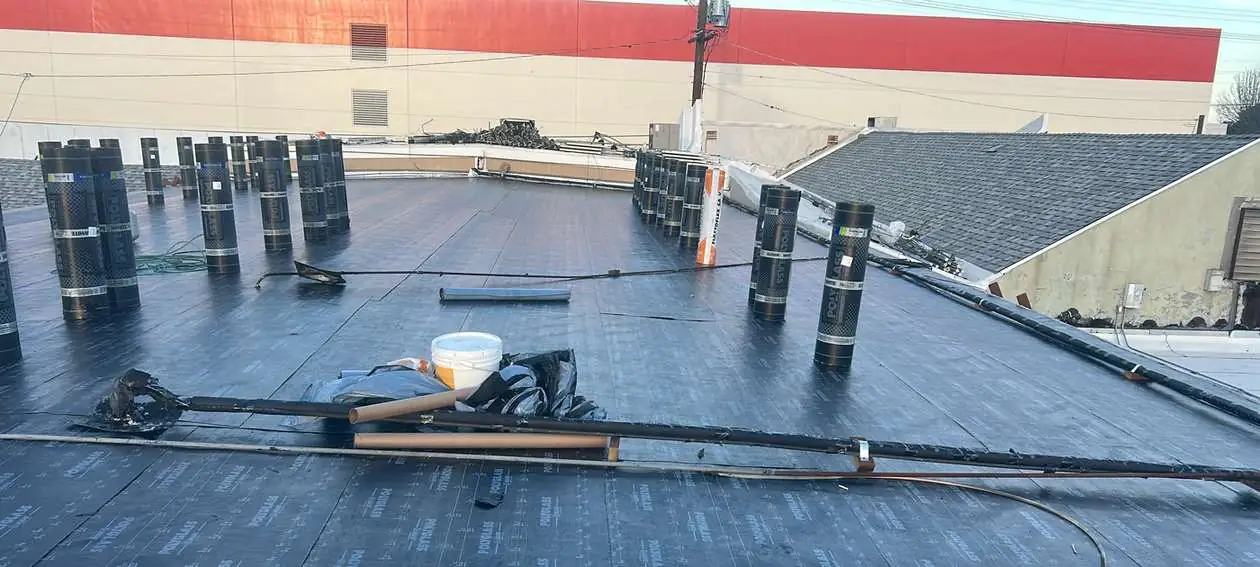
A heat-welded modified bitumen system goes down in overlapping sheets sealed at every lap. Our page on torch-applied modified bitumen covers how that assembly gets built.
A wide welded sheet suits some buildings, and single-ply TPO is one of those options. A project specification often settles that question on its own.
Turn-ups at a parapet and closures at a drain follow published details. Membrane manufacturers set those drawings out themselves, and Polyglass publishes its own in its technical resources.
Some addresses carry several roofs, or mix pitched and low-slope areas together. Our commercial roof work page covers that whole property view.
Where a building needs a written record of the whole roof, start with a documented roof report.
Commercial Flat Roof Questions Owners Ask
What signs or issues indicate my business needs a new roof?
Wet insulation spreading across the field is the strongest sign. Repeated patching at the same details points the same way, and neither shows from the surface.
What roofing material should I choose?
The deck, the drainage and the equipment on the surface narrow that choice. What already covers the roof matters too. We go through the options once we know those things.
How often should a commercial roof be inspected?
No single interval fits every building, so we will not put a number on it. Heavy rain and any work on the rooftop equipment are both worth a look afterward.
A quote for the repair or replacement work is free. Ask for the documented roof inspection when a lender, a buyer or an insurer wants paperwork.
Describe the Membrane and How the Roof Drains
Call (626) 240-1360 with the surface, the drainage and anything you know about the layers. The membrane question comes after those three.
If a leak is active, lead with that. An open leak changes what happens first.
Low-Slope Commercial Coverage Around Pasadena
We repair and replace commercial flat roofs across Pasadena. East Arroyo carries the 91103 ZIP code, and Washington Square carries 91104. Singer Park carries 91105, and Madison Heights carries 91106.
Pasadena Roofing Contractors repairs and replaces flat roofs in Pasadena CA. Call us at (626) 240-1360. Find Pasadena Roofing Contractors on Google Maps.
Find Pasadena Roofing Contractors on Google Maps
Pasadena Roofing Contractors
Pasadena CA
(626) 240-1360