
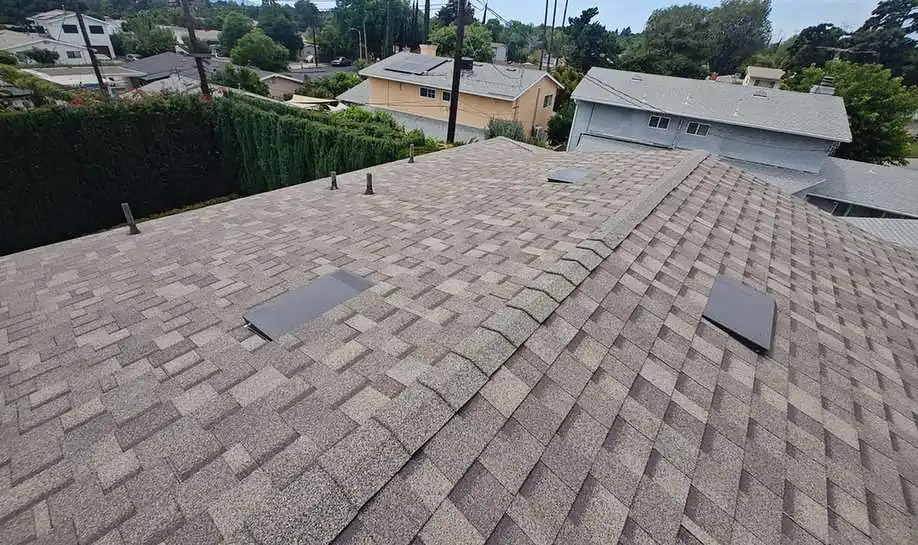
An asphalt shingle roof is four layers working together, and each layer carries a separate responsibility. The wood deck supports everything above it, and underlayment over that deck provides a secondary water barrier. Shingles lock into courses across the slope, and metal flashing closes every joint, edge and opening.

The Layers That Make Up an Asphalt Shingle Roof
Each layer does different work, so each one fails in its own way and on its own schedule. Knowing which layer actually let go tells us how much of the covering has to come apart.
Shingles do the visible work on a roof, and they take almost all of the sun. A strip of adhesive on each shingle bonds it to the course below once the weather warms. That bond is what keeps a tab lying flat when wind pushes up underneath it.
Where Shingle Roofs Give Out First
Shingle roofs give out at the joints and edges long before the open field wears through. Chimney flashing, wall lines, valleys, vent boots and drip edge each handle more water than open shingle. The field itself goes last, once the surface granules have worn away and the mat shows.
Most of the early warning signs on a composition roof show clearly from the yard.
- Curled or lifted tab corners appear on one slope while the courses elsewhere still lie flat.
- Granules in the gutter wash down after rain and collect under the downspout in a dark pile.
- Bare patches show up where the surface color has gone flat and the texture has worn smooth.
- Missing shingles turn up after a windy stretch, most often along a rake edge or the ridge.
- Raised nail heads push up through the covering and stand slightly above the shingle surface.
A stain on a ceiling is a different problem, because water travels before it finally drops. Start with finding where the water actually gets in when the mark inside is what worries you.
Shingle Roof Repair or a Full Shingle Replacement
We choose between a shingle repair and a full replacement by reading what the covering is doing. We repair when the failure sits in one area and the courses around it stay sealed. We re-roof when the shingles have failed slope after slope instead of in a single place.
A shingle repair takes more than a smear of sealant over the damaged area. We break the seal on the courses above, pull the nails, and slide the failed shingles out. New shingles then weave into the surrounding field so water runs over the joins.
Nail placement decides how long a shingle patch actually holds on the slope. A shingle nailed too high misses the course below and leans on its adhesive strip alone. That shows up later as a band of lifted tabs across the same slope.
Wind damage often looks worse from the ground than it turns out to be. One gust can strip tabs off a single plane and leave the rest of the roof sealed. We check whether the adhesive bond let go or the nails pulled through the mat.
Shingles that have gone hard and brittle across the building need replacing, not patching. We say so plainly, and we price a new covering over the whole house. Where one area failed on an otherwise sound roof, a shingle repair is what we scope.
What a Shingle Tear-Off Uncovers
A tear-off removes the old shingles and underlayment down to bare wood. Nothing on the deck remains hidden at that moment, so we establish the scope from what is actually there. We address four separate items before any new material goes back down.
The Wood Deck
The wood deck is the first thing we examine. We discover plywood that has separated into layers, boards cut short at a valley, and old vent openings. Every fastener above has to hold in that wood, so the softened boards come out first.
New Underlayment Across the Whole Deck
Fresh underlayment goes over the entire deck before a single new shingle returns. The courses lap downhill, so water sheds across each seam instead of running into it.

Flashing, Drip Edge and the Starter Course
Wall lines, chimney sides, valleys and pipe openings all take new metal while the roof is open. Drip edge goes on at the eaves and rakes, and a starter course sets the first row. Setting old flashing back under new shingles is where a fresh re-roof leaks first.
Intake and Exhaust Ventilation
Intake at the eaves and exhaust near the ridge only work as a matched pair. Blocked intake leaves the exhaust side with nothing to draw, so we settle both while the deck is bare.
Not every shingle project strips the whole house down to the deck. Where one plane has failed and the others still shed water, we rebuild that plane alone. The deck check runs exactly the same way on a single slope.
Choosing Shingles When the Assembly Has to Carry a Rating
A fire rating belongs to the finished assembly, not to a shingle on its own. So we pick the covering and the layers under it together, as one build. We read the manufacturer's assembly documentation for the exact build we intend to install.
Then we tell you exactly what that documented build is listed for. Slope, wind exposure and what the framing can carry all narrow the choice further.
Whether a rating requirement actually reaches your property is a separate question. Our guide to Class A requirements in mapped Pasadena zones works through the maps and the scopes involved.
Shingle Roofs That Have Been Re-Roofed Before
Plenty of shingle roofs here are not on their first covering, and that changes the work. About 73 percent of Pasadena's housing units were built before 1980. Older houses often sit on board sheathing with gaps between the boards, and a nail holds differently there.
Old patches, mastic smears and re-flashed wall lines all mark where somebody already fought water. Those repairs meet each other at seams, and the seams are what we open first.
Tell us if a roofer has worked on the house before. What that earlier work left behind changes what a tear-off turns up.
A shingle re-roof can call for a roofing permit, and the scope of the work decides that. We help property owners through that permit process. Pasadena's Permit Center handles these properties.
Asphalt Shingle Roofing in Pasadena, CA
Asphalt Shingle Questions We Hear on the Phone
Is an asphalt shingle roofing quote free?
Yes, a shingle quote is free, and that covers both a small repair and a full re-roof. A documented written roof report is separate paid work, so name the one you actually need.
Can you repair asphalt shingles instead of replacing the roof?
Yes, as long as the failure sits in one area and the shingles around it stay sealed. We swap the damaged courses and weave the new shingles into the field around them. Once the shingles have failed slope after slope, we price the re-roof instead.
How can I tell how old the shingles are?
Permit records, an inspection report from the purchase, or the last roofer's invoice usually carry that date. A rough answer helps us, and no answer at all is still fine. We read the roof on its own condition either way.
Describe the Shingles and We Will Price the Work
Call (626) 240-1360 and describe what the shingles look like from the ground. Curled tabs, a bare patch on one slope, or grit in the gutter are all fine starting points.
Have the property address ready, and say whether the house is one story or two. Both details change how we stage a shingle job and how we move material.
We quote shingle work in every part of the city. East Arroyo sits inside 91103, and Orange Heights sits inside 91104. South Allen falls in 91106, while Eaton Blanche Park sits over in 91107.
Our listing on Google reads Pasadena Roofing Contractors, Pasadena CA. Where a house needs more than shingle work, we cover the other systems on a house roof too. Call (626) 240-1360 and the shingle quote costs you nothing.
Find Pasadena Roofing Contractors on Google Maps
Pasadena Roofing Contractors
Pasadena CA
(626) 240-1360