
Roof damage becomes an emergency once the covering opens and weather keeps getting inside the building. A torn lap on a flat roof counts, and so does a slipped run of tile. Lifted flashing at a wall counts as well, and so does a hole over a room you use.

Sudden Roof Damage That Leaves the Roof Open
Wind opens a roof in its own way, peeling back a section of cap sheet or lifting a ridge. A falling branch does something different entirely and drives straight through the roof deck.
Older roofs usually open at a seam or a flashing joint rather than in the open field. A single storm can open more than one spot on the same roof.
An open roof takes in more water every time the weather turns against the building. The covering has to close before anything underneath it can begin to dry out properly.
Call (626) 240-1360 and name the part of the roof that opened up. That single detail already tells us a great deal about the work ahead.
How Emergency Roof Repair Closes an Open Roof
An emergency roof repair closes the roof at the exact point where the covering actually broke. Our roofers work that entry point rather than the wet patch on the ceiling below it. We close the opening with the material the roof already uses, so the covering decides the method.
On a tile roof we reset the slipped and broken pieces and repair the underlayment beneath them. A cracked tile alone rarely explains the water, because the underlayment underneath carries most of it. We open that lower layer below the break and set your original tile back over it.
On a flat or low-slope roof our crew works the laps, the seams and the drainage points. We clean, dry and heat weld a lifted lap back down onto the membrane below. We clear a blocked drain as well, because standing water keeps working at a weakened seam.
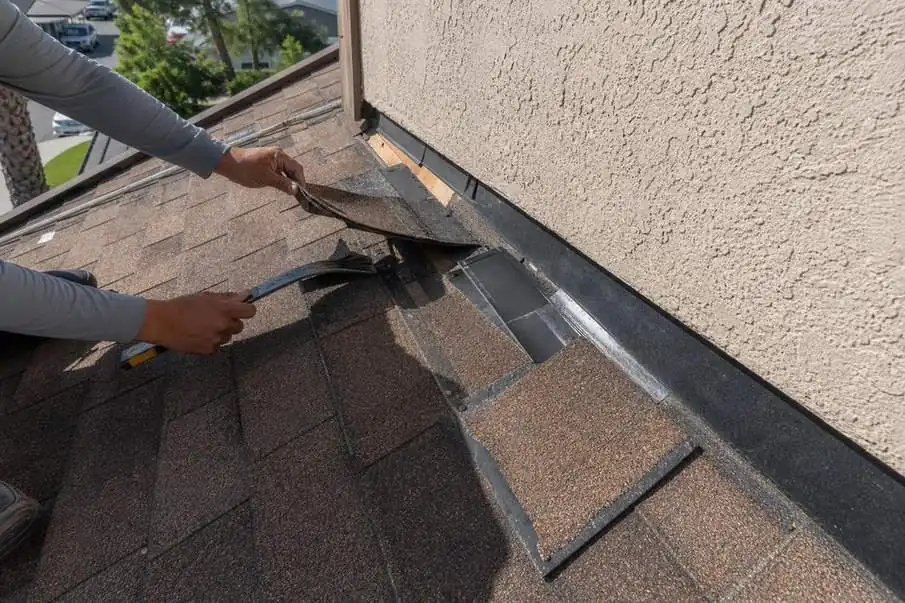
On a shingle roof we replace loose and missing shingles, then reseal the metal at walls and valleys. Metal roofs open at the fasteners and the panel laps instead of across the field. We reset the panel and replace the sealing washers rather than patching over the seam.
We check the roof deck wherever water has already reached the wood below. Where a branch or a long soaking has left boards spongy, that wood comes out first. New covering only goes down over sheathing that is sound.
Staying Safe While the Roof Is Open
Deal with the water inside the building and leave the roof surface itself to our roofers. Move whatever you can out of the water's path and set a container under the drip. Empty that container regularly, before it has any chance to overflow.
Stay off the ladder and off the roof while the covering is still open. OSHA's roof inspection safety guidance describes roof surfaces that can be steep, slippery or weakened by damage.
A bulging ceiling holds a lot of water in one place, so keep people out of that room. FEMA's safety tips for a damaged home make the same point about a ceiling sagging under water.
Call us from a safe spot inside the building, or from the ground outside it. Nothing you could see from the roof itself would change what the repair actually needs.
What to Describe on an Emergency Roof Call
Describe the property address, the roof covering, and where the water shows up inside the building. Those details tell us most of what we need before we price anything. None of them has to be exact, because a rough idea still helps us.
- The property address, so we know exactly which roof we are discussing with you.
- The covering on the roof: tile, asphalt shingle, flat or low slope, or metal.
- Where the water shows up inside, such as a ceiling, a wall or a light fixture.
- What you noticed outside, such as tile on the driveway or a lifted corner of cap sheet.
- How many stories the building has, because height changes how we reach the damage.
- Whether water is still coming through while we are talking on the phone.
Water that is still moving tells us the opening remains live, which changes what the repair must close. Tell us as well if nobody has been outside to look at the roof yet.

Temporary Stabilization Versus the Durable Repair
A temporary cover holds weather out of an opening that the roof cannot close on its own. The durable repair follows once the surface is dry enough for new material to bond well. The cover is a holding step, and the roof still needs the permanent work underneath it.
Where a temporary cover is the right step, we say plainly which part of the work is temporary. That way you know exactly what is finished and what still has to be built back.
A durable repair replaces the layer of the roof that actually failed under the weather. That means new flashing, fresh underlayment, or a rebuilt seam underneath the finished covering.
Weather also limits how much of the work we can finish during a single stretch. Some roofing materials need a dry surface before they will bond to the roof at all.
What an Emergency Roof Repair Quote Covers
The emergency roof repair quote covers the work we propose on the damaged roof, and it costs nothing. We look at the opening, the covering around it, and any wood that has gone soft. The size of the opening matters much more than the size of the whole roof.
We take emergency roof calls across Pasadena, and the covering matters far more than the ZIP code. That includes houses around Altos Arroyo in 91105 and buildings near Villa Corona in 91106. We take the same calls out toward East Orange Grove in 91107.
Give us the property address and a plain description of the damage, and we work from there. Partial information is still useful, because the covering and the opening shape most of the pricing.
After the Roof Is Closed
Once the roof is closed and dry, the remaining work belongs with whichever repair actually fits it. A single wet spot on an otherwise solid roof usually belongs with roof leak repair. That page covers tracing water back through the roof to its original entry point.
Storm damage held to one area of the roof lands with roof repair on that section. Flashing, valleys and a length of underlayment are usually the parts we rebuild there.
Sometimes a storm only exposes a covering that was already breaking up across the entire roof. When that is what we find, a full roof replacement becomes the conversation instead of another patch.
Permits follow the scope of the follow-up work rather than the storm itself. Where that work needs a roofing permit, we help property owners pull it from the city that issues it.
Emergency Roof Repair in Pasadena, CA
Emergency Roof Repair Questions We Hear
How urgent is roof repair?
It depends on whether the roof is open and weather keeps reaching the inside. That kind of opening is emergency work rather than a normal repair. The longer that roof stays open, the more of the deck below gets wet.
What is considered a minor roof leak?
A small stain from a single point, with the covering around it still sound, stays a smaller job. Water coming through faster, or showing in several places, points to a wider opening. Describe what you see on the call, and we will work through it with you.
Can you fix a leaking roof while it's raining?
Rain and wet surfaces can limit safe and effective work on the roof. Some materials will not bond until the surface underneath them is dry. Call and describe the opening, and we will explain the next step available.
Describe the Opening and the Covering
Call (626) 240-1360 from a safe spot and say what opened and where water shows inside. Name the covering as well, because tile, cap sheet and shingle each close differently.
Google lists our profile as Pasadena Roofing Contractors, Pasadena CA. The line there is the same one, (626) 240-1360, and the emergency quote costs nothing.
Find Pasadena Roofing Contractors on Google Maps
Pasadena Roofing Contractors
Pasadena CA
(626) 240-1360